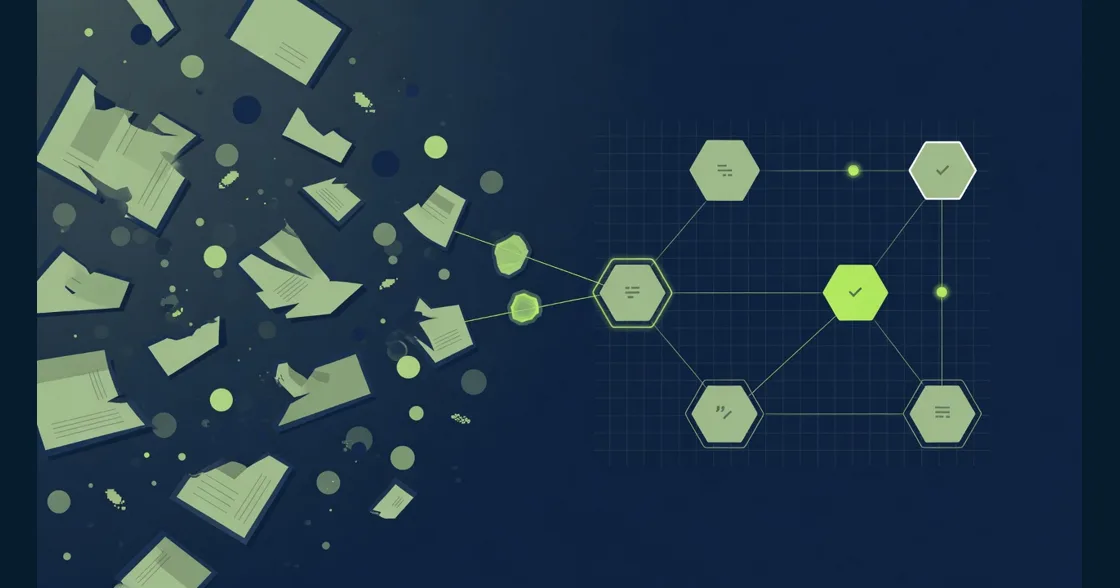
For roughly three years, the default engineering answer to any enterprise AI context problem was automatic: build a RAG pipeline. Chunk the PDFs, generate embeddings, retrieve by similarity at runtime. For fuzzy, exploratory search, that was, and still is, a reasonable tool.
By 2026 the cracks are harder to ignore. Chunking flattens structure that mattered. Retrieval is probabilistic: you might get the right passage, or an outdated cousin that merely sounds right. Keeping embeddings synchronized with live commercial knowledge is an operational tax teams underestimate until answers start confidently citing last year’s deck.
This is not an argument that vector databases are dead. It is an argument that high-stakes organizational truth is the wrong job for nearest-neighbor search alone, and that agents need a navigable map of what the organization already knows, with citations and known gaps, not only a haystack of similar text.
What breaks when everything is a chunk
Four failure modes show up again and again when RAG is treated as the only memory layer:
- Structure loss. Reporting lines, multi-lane buyer processes, and tables do not survive split-and-embed intact. The model sees fragments; the org chart and process map never reassemble unless something else rebuilds them.
- Similarity is not correctness. Cosine distance optimizes for “looks related,” not “is current, owned, and canonical.” A 2023 pricing one-pager can outrank the 2026 contract clause that actually governs the deal.
- Embedding sync is ops hell. Every meaningful edit wants re-chunk, re-embed, re-index. Teams either pay that cost continuously or silently serve stale vectors.
- Conflicting sources, no owner. Slack threads, old Confluence pages, and live MSAs all enter the index as equally plausible text. The model blends them. Nobody signed off on the blend.
We wrote earlier about why enterprise RAG plateaus at mediocre answers: governance, freshness, provenance, and noisy context, not the choice of retriever. This post is the architectural half of that story: what you put under the answers that must not be a coin flip.
A scenario teams recognize
Ask an agent: “Who is the economic buyer on Acme, and where are they in the buying process?”
RAG-only path. The query becomes an embedding. The index returns a mix: a discovery-call transcript from Q1, a CRM note that says “champion = Erlich,” a Slack debate about whether procurement is in, and a persona deck from a different engagement. The model reconciles conflicting labels into a fluent answer. It may even cite three sources that disagree. The rep still has to re-open the files to know what is true.
Map path. The agent (or the human UI) lands on a persona and a buyer-process view for that account: discrete facts such as “Erlich is economic buyer” and “stage advanced when procurement joined,” each linked to a quote or document span, with known gaps called out when signing authority is still unconfirmed. Corrections flow through review. Superseded claims are not shown as current.
Same question. Different failure surface. One system optimizes for recall of text; the other optimizes for a maintainable model of the account.
RAG vs. a governed knowledge layer
| Dimension | RAG-only | Governed knowledge layer |
|---|---|---|
| Core unit | Segmented vector chunks | Atomic facts with evidence, assembled into shapes |
| Retrieval | Probabilistic nearest neighbor | Structured and graph paths; search when exploring |
| Human interface | Query a store; hard to correct in place | Readable views (org, persona, process) with edit paths |
| Maintenance | Re-index and re-embed as the corpus moves | Review, promote, supersede; provenance is the audit trail |
| Best fit | Wide archives, fuzzy discovery | Canonical definitions, roles, stages, commercial claims |
Notice the table does not say “replace the vector database.” It says stop using the vector database as the source of truth for claims that need an owner.
Hybrid, not holy war
The useful architecture is a router, not a religion:
- Governed layer for definitions, org structure, persona attributes, process stage, policies, and anything you would be embarrassed to get wrong in front of a client.
- Retrieval layer for long-tail archives, historical exploration, and questions that genuinely need “something like this somewhere in the corpus.”
Industry discussion of portable, markdown-and-graph “knowledge bundles” is circling the same idea from another angle: progressive disclosure, explicit links between concepts, and agents that maintain structure rather than only retrieving blobs. The comments on those pieces are also right to pressure-test the hard part: if agents write the graph, traversal can be deterministic while the content is still wrong. Authority without verification is worse than a bad chunk, because the bad answer ships with an owner field and a timestamp.
That is why citations and known gaps are not polish. A claim without a verifiable quote is a guess. A missing field modeled as a gap is a discovery task. Confidence without either is theater.
What this means for builders
If your retrieval metrics already look fine and answers still feel mediocre, the next dollar rarely belongs to another embedding bake-off. It belongs to:
- Atomic, cited claims extracted from sources you already have (calls, contracts, notes), not only whole-chunk paste.
- Shapes people expect: org charts, personas, process maps, built from those claims so structure is restored after ingestion.
- Supersession and review so current beats similar-but-stale.
- Explicit absence so agents can ask for what is missing instead of inventing it.
- A hybrid path that still uses semantic search for scale, without forcing every decision through cosine similarity.
That stack is what we are building with FELLOW: documents in, cited facts out, assembled into views humans can correct and APIs agents can trust. See the platform comparison for the side-by-side, or the product overview for the end-to-end flow.